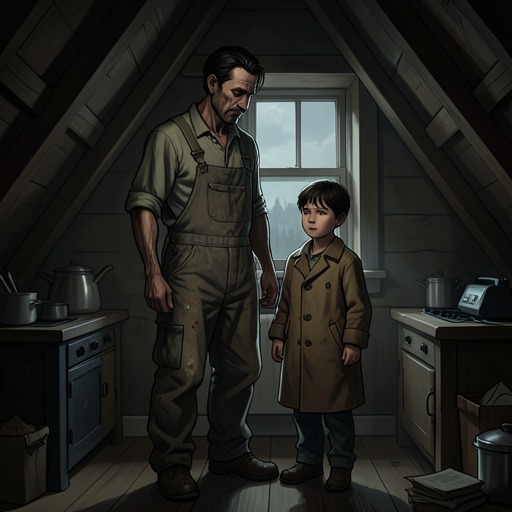
Vilna Lutz’s recurring fever and delirium
The Magician's ElephantVilna Lutz’s recurring fever and delirium repeatedly unsettle his role as Peter Augustus Duchene’s stern military guardian. In these episodes, ordinary concerns become rigid commands, contradictory reasoning, and visions of battle; between them, his speech returns to the dull order of soldierly instruction. The recurrence makes his illness part of the household’s daily life, and its final scenes place him in the care of Adele as well as Peter.
Symptoms and Pattern
The episodes are marked less by a stable set of symptoms than by changes in Vilna Lutz’s speech and judgment. During one morning at the market, Peter recognizes that his guardian is again feverish because the old soldier’s explanations have ceased to make sense. Vilna Lutz connects mouldy, hard bread to strong teeth, strong teeth to a strong heart, and a strong heart to bravery. Peter cannot follow the logic, but the certainty with which Vilna Lutz asserts it is part of the episode’s distinctive character.
The fever also turns practical errands into tests of military obedience. Vilna Lutz orders Peter to bring back exactly two fish, preferably the smallest ones, and insists that he must not return empty-handed with what he calls the lies of fortunetellers. His speech veers into repetition and self-correction: he denounces fortune-tellers, then interrupts himself to insist that calling their words lies is redundant. Peter is left to carry out the demand while trying to anticipate what the unpredictable old soldier might say or do.
Cold is another recurring feature, but it does not follow the weather. Even in summer, when seized by the strange fever, Vilna Lutz complains of the cold and demands that the window be shut. In winter, he can make the same demand while the actual season already gives him reason to feel cold. The recurrence blurs the boundary between bodily sensation and his surroundings: the complaint belongs to the illness, yet it becomes a familiar instruction for those around him.
Fever and Military Delusion
The fever draws on Vilna Lutz’s soldierly identity but distorts its ordinary discipline. When Peter tries to tell him that an elephant has arrived, Vilna Lutz dismisses elephants as imaginary beasts and demons, then abruptly asks whether he can hear muskets and cannon. The exchange moves from disbelief to an imagined battlefield without explanation. His military vocabulary remains intact, but its application has become detached from the immediate scene.
When the fever recedes, that same military world takes a more orderly form. Vilna Lutz has trimmed his beard to a point and is arranging lead soldiers on the floor to demonstrate a battle strategy. He explains a flanking manoeuvre and asks Peter whether he admires the general’s execution of it. The episode provides a contrast rather than a complete cure: his words have returned to what the narration calls an unremarkable military sense, but soldiering still structures the way he teaches, thinks, and relates to Peter.
At a later, particularly high fever, the language of battle breaks down again into cries that are both commanding and vulnerable. Vilna Lutz shouts, “We must outflank the enemy!” and asks, “Where, oh where, is my foot?” He then says, “I cannot take her. Truly, I cannot. She is too small.” The passage does not explain who he means by “her” or what he believes he must do. Its uncertainty is part of the scene: a familiar military imperative gives way to an anxious refusal whose referent remains unclear.
Recurrence and Care
The pattern extends beyond the episodes Peter first witnesses. Later, while the household is singing, a knock comes from the attic apartment. Adele often goes upstairs to find out what Vilna Lutz wants. He cannot answer her properly; he can only say that he is cold and ask for the window to be closed. When a particularly high fever takes hold, he sometimes allows Adele to sit beside him and hold his hand. The illness therefore recurs not just as disordered speech, but as a repeated need for someone to respond to him, close the window, or stay near.
Adele’s care answers the episode without trying to correct or interpret it. When Vilna Lutz speaks of the enemy, his missing foot, and his inability to take someone who is too small, she says, “Shh,” and comforts him. She waits until he falls asleep, then returns downstairs to Peter and the others. The scene gives his fever a domestic consequence: the household’s music pauses for a visit upstairs, and Adele moves between the vulnerable old soldier and the people waiting below.
Narrative Significance
Vilna Lutz’s recurring fever creates a sharp contrast between the authority he claims as a soldier and his dependence on others during an episode. He can order Peter around with conviction, yet his reasoning may collapse into strange associations; later, he cannot answer Adele properly and accepts the comfort of her hand. The illness does not erase his military identity. Instead, it makes that identity visible in fragments, from the market’s commands about bread and fish to the lead soldiers arranged in a battle formation and the final cries to outflank an enemy.
The episodes also make care a repeated action rather than a single transformation. Peter listens, obeys what he can, and tries to manage his guardian’s unpredictable demands; Adele later closes the distance by sitting beside Vilna Lutz and waiting with him. The fever persists, but its recurrence does not leave him entirely alone. Across the novel, the familiar requests to shut the window and the moments when he permits a hand to be held mark a continuing, fragile connection between illness and the people who stay to answer it.